
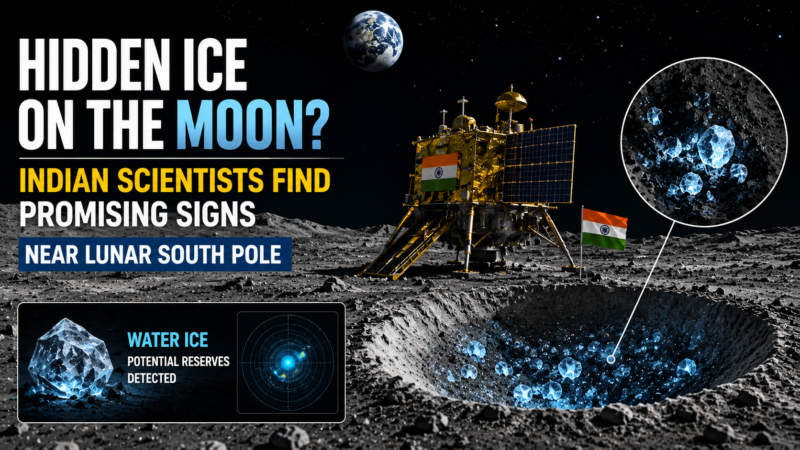
Hidden Ice on the Moon? Indian Scientists Find Promising Signs Near Lunar South Pole
The Moon may be hiding a valuable resource that we need for future space exploration. Indian scientists think they have found clues that point to this.
Researchers have been studying data from the Chandrayaan-2 mission. They think they have found signs that there might be ice under the surface of the Moons pole. We need to do studies to confirm this but it is very exciting for the scientific community. This is because it could be very important for missions to the Moon.
The idea that there might be water under the Moons surface is not new.. Every new piece of evidence helps us understand the Moon better. We want to know if it will be possible for humans to live on the Moon for a time.
Why the Moons South Pole Matters
For a time scientists have thought the Moons south pole was one of the most interesting places in our solar system.
Some craters near the pole are always in shadow. This means the sun never shines on them. These areas are very cold. Can keep water ice for billions of years. The temperatures in these craters can be colder than places in outer space. This makes it a good place for water ice to exist without melting.
Because of this the south pole is an important place for space agencies to study.
What Chandrayaan-2 Discovered
The Chandrayaan-2 mission was launched by ISRO in 2019. It is still sending back information about the Moon.
Scientists have been analyzing the data from the mission. They think they have found signs that there might be ice under the surface of the Moon near the pole. They made these observations by studying the Moons terrain and surface. The signals they detected are consistent with the conditions needed for ice to exist.
Although we do not have proof of ice deposits yet this discovery makes a strong case for further investigation.
Why Water on the Moon Is Important
Finding water on the Moon would be a big deal. It would be more than a scientific discovery.
Water is essential for life. We can drink it use it to make oxygen and even use it as rocket fuel. If astronauts can access water on the Moon they will not need to bring many supplies from Earth. This would make it easier and cheaper to send missions to the Moon.
Many experts think that water on the Moon could help us establish bases there.
A New Era of Lunar Exploration
There is a lot of interest in the Moon now.
Many countries, including India, the United States, China, Japan and Russia have sent missions to study the Moon. The south pole is an important place because it might have resources that we need for future exploration.
NASAs Artemis program, Chinas initiatives and Indias Chandrayaan missions are all interested in the south pole. As we gather information we are getting a better picture of what the Moons surface is like.
Indias Growing Role in Space Science
Indias space program is getting a lot of recognition.
The Chandrayaan program has helped us learn more about the Moon. Other missions like Mangalyaan have shown that India can explore space. The Chandrayaan-2 mission is still providing data that helps us answer questions about the Moon.
This reinforces Indias position as a contributor to global space research.
What Happens Next?
Scientists say we need to do research to confirm the presence of ice on the Moon.
Future missions might be able to investigate the pole more closely. They could use instruments to determine how much ice is there. We might even be able to send landers or drilling equipment to get samples.
Until then the findings from Chandrayaan-2 are another clue in the mystery of the Moons ice.
Looking Toward the Future
The possibility of ice on the Moon is very exciting.
If we find ice deposits it could change the way we explore space. Water on the Moon would support astronauts and could even help us send missions to Mars and beyond.
For now the latest findings from Chandrayaan-2 remind us that the Moon still has secrets. As scientists continue to study the Moon and plan missions the dream of a human settlement on the Moon seems closer, than ever.


No Comments