
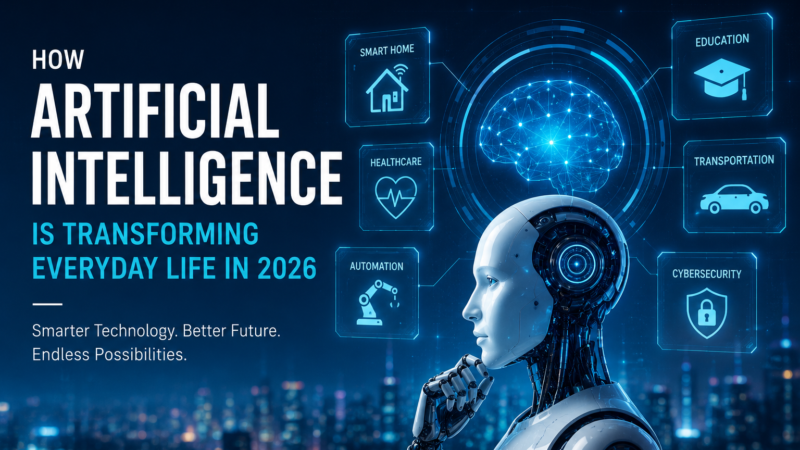
How Artificial Intelligence Is Transforming Everyday Life in 2026
Technology has become deeply integrated into modern life, but no innovation has changed the world more rapidly than Artificial Intelligence (AI). What once seemed like futuristic science fiction is now part of our daily routines, businesses, healthcare systems, education platforms, and even entertainment experiences.
In 2026, AI is no longer limited to tech companies or advanced research labs. It has become a mainstream technology that helps people work smarter, communicate faster, and make better decisions. From virtual assistants and smart homes to AI-powered healthcare and personalized recommendations, artificial intelligence is shaping the future in ways that were unimaginable just a few years ago.
As technology continues to evolve, understanding the impact of AI on everyday life is more important than ever.
What Is Artificial Intelligence?
Artificial Intelligence refers to computer systems designed to perform tasks that normally require human intelligence. These tasks include learning, problem-solving, decision-making, speech recognition, language translation, and visual understanding.
Unlike traditional software that follows fixed instructions, AI systems can analyze large amounts of data, identify patterns, and improve their performance over time through machine learning.
Today, AI powers everything from recommendation algorithms on streaming platforms to fraud detection systems used by banks and cybersecurity companies.
The rise of generative AI has also transformed content creation, allowing businesses and individuals to generate text, images, videos, and even software code within seconds.
AI in Everyday Life
Many people use AI daily without even realizing it.
Smartphones use AI for voice assistants, facial recognition, camera enhancements, predictive text, and navigation systems. Streaming services recommend movies and music based on user behavior, while online shopping platforms personalize product suggestions according to browsing history.
AI has also improved digital communication. Email spam filters, real-time language translation, and automated customer support systems have become more efficient and accurate.
Smart home devices such as voice-controlled speakers, automated lighting systems, and intelligent security cameras are making homes more convenient and energy-efficient.
In 2026, AI is becoming increasingly invisible — seamlessly integrated into the technologies people already use every day.
The Future of Work and Automation
One of the biggest discussions surrounding AI is its impact on jobs and the future of work.
Automation is changing industries by handling repetitive and time-consuming tasks more efficiently than humans. Businesses are using AI-powered tools for data analysis, scheduling, customer support, marketing, and workflow optimization.
Rather than completely replacing humans, AI is increasingly working alongside employees to improve productivity and decision-making.
Professionals in fields such as healthcare, finance, education, and design are using AI tools to save time and focus on more creative or strategic responsibilities.
At the same time, the demand for digital skills is growing rapidly. Careers related to AI development, cybersecurity, cloud computing, and data science are becoming some of the most valuable roles in the technology industry.
Learning how to work with AI tools is expected to become an essential skill for future professionals.
AI Is Revolutionizing Healthcare
Healthcare is one of the industries benefiting most from artificial intelligence.
AI-powered systems can now assist doctors in diagnosing diseases more accurately and quickly. Medical imaging tools use machine learning algorithms to identify patterns that may be difficult for humans to detect.
Virtual health assistants and wearable devices help patients monitor heart rate, sleep quality, blood pressure, and fitness levels in real time.
AI is also accelerating medical research by analyzing large datasets and helping scientists discover potential treatments faster than traditional methods.
Telemedicine platforms powered by AI are improving healthcare accessibility, especially for people living in remote areas.
As healthcare technology continues to advance, AI has the potential to improve patient outcomes while reducing costs and increasing efficiency.
Cybersecurity in the Age of AI
As technology evolves, cybersecurity has become more important than ever.
AI is playing a major role in identifying cyber threats, detecting unusual behavior, and protecting sensitive information from hackers.
Traditional security systems often struggle to keep up with rapidly changing cyberattacks, but AI can analyze patterns and respond to threats in real time.
However, cybercriminals are also using AI to create more sophisticated scams and attacks, making digital security a continuous challenge.
Businesses and individuals must remain cautious by using strong passwords, enabling multi-factor authentication, and staying informed about online safety practices.
The future of cybersecurity will heavily depend on advanced AI systems capable of adapting to emerging threats.
The Rise of Smart Cities
Cities around the world are becoming smarter through AI-powered infrastructure and technology.
Smart traffic systems can reduce congestion by analyzing real-time transportation data, while AI-powered energy grids help optimize electricity consumption.
Public transportation systems are also improving through predictive maintenance and intelligent route planning.
Many cities are adopting AI technologies to improve waste management, water conservation, public safety, and environmental sustainability.
As urban populations continue to grow, smart city innovations will play a major role in creating more efficient and sustainable communities.
Ethical Concerns Around Artificial Intelligence
Despite its benefits, AI also raises important ethical questions.
Privacy concerns are growing as companies collect large amounts of personal data to train AI systems. People are becoming more aware of how their information is stored and used.
Bias in AI algorithms is another major concern. If AI systems are trained on biased data, they may produce unfair or inaccurate outcomes.
There are also debates about misinformation, deepfake technology, and the potential misuse of AI-generated content.
Governments and technology companies are now working on regulations and ethical guidelines to ensure AI is developed responsibly and transparently.
The future of AI will depend not only on innovation but also on accountability and trust.
The Growth of AI in Education
Education is rapidly evolving with the help of AI-powered learning tools.
Students now have access to personalized learning experiences, intelligent tutoring systems, and virtual classrooms that adapt to individual learning styles.
AI can identify areas where students struggle and provide customized recommendations to improve performance.
Teachers are also benefiting from automation tools that assist with grading, lesson planning, and student progress tracking.
Online education platforms powered by AI are making learning more accessible to people around the world.
In 2026, technology is helping create more flexible, interactive, and efficient educational experiences.
Final Thoughts
Artificial Intelligence is no longer a distant concept — it is actively transforming the way people live, work, learn, and communicate.
From healthcare and education to cybersecurity and smart cities, AI is shaping the future of modern society.
While challenges related to ethics, privacy, and job transformation still exist, the opportunities created by AI are enormous.
The key to embracing the future lies in understanding how technology can enhance human potential rather than replace it.
As innovation continues to accelerate, Artificial Intelligence will remain one of the most influential technologies of the 21st century — changing everyday life in ways we are only beginning to understand.

No Comments